Thursday, July 7, 2016

Archibald Robertson, lieutenant-general, Royal Engineers.1745-1813 From: his diaries and sketches in America, 1762-1780.

Archibald Robertson's Diaries and Sketches are an extraordinary eye-witness account of the Revolutionary War.  He had accompanied Gen. Howe for most of the engagements from 1776 to 1778, and upon arriving at New York in the summer of 1776, described the landscape and troop movements in and around Staten Island.  The following excerpts start with the British fleet approaching Sandy Hook and anchoring off the coast of Staten Island in late June and includes the preparations for what would be the Battle of Long Island in August

Major Archibald Robertson of Lawers 1782 by George Romney The Museum of Fine Arts in St. Petersburg, Florida

[June] 29th at 6 in the morning discovered land the heights call'd the Neversinks close by sandy hook the Entrance intoNew York Bay, and all the Fleet got safe to an Anchor at 3o'clock behind the Hook. Have had very calm weather for 10 Days past with light Breezes from the East. Dth a fair wind but lay still. Wrote my Brother and nclos'd the 2d of Exchange for £200 Sterling drawn by Captain S: in his favour.
July 1st within 20 Minutes of 5 afternoon the Admiral made the signal to get under way, and in an hour all the Fleet were under sail for the Narrows with a fair wind. Came to an Anchor about 2 miles off Gravesend on Long Island, about 8 o'clock, and went with Captain [John] M[ontreso]r immediately on board the Admiral. There was orders for the troops to be ready to embark at 4 next morning, but after a long Consultation of General Officers it was agreed not to be proper, considering the country we had to march thro' and the Difficulty of keeping up our Communication with the Ships, etc., etc.

[July] 2nd Weigh'd Anchor at 10 morning and stood for the Narrows, the Tide just on the turn against us and a light Breeze. At 11 The tide turn'd and becoming allmost Calm and the wind ahead the Transports fell into great Confusion all dropping upon one another without steerage way which obliged us to come to an Anchor. Some of the ships with in 7 or 800 Yards of Long Island. We observed a good many of the Rebels in Motion on shore. They fired musquetry at the nearest Ships without effect. About 12 the ships nearest were ordered to drop down with the Tide, lucky for us the Rebels had no Cannon here or we must have suffered a good deal.

The Phoenix, Grayhound and Rose men of war got about 4 or 5 miles ahead and brought too. About 4 past one the Phoenix made the signal for preparing to land. It rain'd smartly, and the ist division of Transports got under way with the first of the flood Tide, and about 9 we got up to the Watering Place on Staaten Island where the 3 men of war had hauled close inshore, the General on board the Greyhound, and the Grenadiers and Light Infantry under Earl Percy. Generals Robertson and Leslie landed immediately without opposition, the inhabitants wellcoming them ashore. They lay near the landing Place all night.

July 3d about 6 morning landed with the General. Part of the ist Brigade landed, and all the Troops ashore, about 2300, march'd along the North side of the Island by Deckers Ferry, and part advanced to Elizabeth Ferry, Richmond, etc. In the Evening some more troops were landed. The Admiral got up, but few of the transports, to the Watering Place. 4 Grasshoppers were brought to Deckers Ferry.

July 4th Last night the Rebels brought two pieces of Cannon to Deckers's Ferry, one 12 and one 9 pounder, and Early in the morng fired on the George Sloop and kill'd and wounded 5 men, but the sloop drove them off with the loss of one man and some wounded. The General would not allow the Grass hoppers to be fired. This day we brought up 2 12 -pounders and 2 Royal Howitzers near Deckers Ferry. The Rebels fired from a field piece at our Transports coming up the Narrows. The Asia return'd the fire and drove them off. All the troops landed. This night a Sloop came in from Shrewsberry in the Jerseys with 66 men in Arms to join the Army under Mr. Morris formerly an Officer in the 47th Regiment. Landed the entrenching tools with the Cannon.

The Emerald Arrived with a Ship loaded with Provisions from the Loyalists at New York. Several People came in, in Boats from Long Island and the town, most horridly persecuted by the Rebels.

[July] 5th nothing Extraordinary but reconnoitring the Enemy's works they began to throw up opposite Elizabeth- town Ferry the 3d, which we found very slight and ill constructed. This day pitch'd my tent. A party of 50 Sailors of the Asia brought off some Cattle from the point at the Kills.

6th reconnoitered our post at Richmond, the Quarters of the Grenadiers. Staid all night, saw the Militia review'd, supposed to be 700 and a troop of light Horse.

7th return'd to head Quarters. The Rebels last Evening fired a good many Musquet shot across the water at Decker's Ferry without Effect. Some People come in from long Island and 3 Rifflemen with 5 Riffle Guns, an English, Scotch and Irishman.

The Militia mounted a Guard on the General of 12 Light Horse.

8th Wrote to Lord Townsend, Lord Cathcart, and Henry, to go by the same Pacquet with my letter of 30th Ultmo. This Evening the Rebels fired musquetry at Decker's Ferry, but dispersed on a gun or two being fired.

9th This morning at 5 we had a working Party of 100 men to cut Fascines at Deckers Ferry to begin a Post which we marked out there for the security of the inhabitants when we leave this Island. This afternoon went to Richmond with Mr. Sproul, to mark out an intended work upon a height near the Town.

10th After looking over and Considering the ground well found some Alterations in the scheme would be necessary. Return'd to Head Quarters. I believe no work is to be made at Richmond.

13th the 1st and 5th Brigades embarked, the Grenadiers took the Quarters of the 1st from Richmond, and the Forreigners encamp'd where the 5th were.

18th this morning the Phoenix and Rose men of war with two tenders came down to the Fleet after having pass'd the fire of all their Batterys in which the Rose had two men wounded. The Night of the 16th they were attack' d by two fire Ships, the Rose's Tender was burnt and the Phoenix narrowly escaped.

22nd Landed on Long Island Gravesend Bay.

26th Ordered to attend General Clinton, I join'd him at 8 in the Evening at flatlands, at 9 we march'd, with all the Grenadiers, Light Infantry, 33d, 71st Regiments and 17th Light dragoons in order to turn the left flank of the Rebel army who were in possession of the high Grounds of Brooklyn, that extend all the way most to Jamaica.

27th at daybreak we pass'd these heights without any op position, about 5 miles East of Bedford and continued our march towards Bedford and Brooklyn. When we came near to Bedford the Rebels began to fire from the Woods on our left which continued for some distance as we march'd on to Brooklyn. Ordered to stop the Light Companies of the 23d I join'd them and obliged to remain, my Communication with the General being cut off. About 9 o'clock the Rebels gave way very fast and in their retreat, across a marsh and mill dam, received a heavy fire from our Grenadiers tho' distant. The Light Horse could not act for a swamp that was in front. At the same time General Clinton went from Flatlands. General Grant march'd from Dinnys's with 2 Brigades to turn the Rebels right Flank and Count Dunhop march'd in the Centre from Flat Bush. General Grant in his march had several smart Skirmishes. A Battalion of our Grenadiers and the 71st were sent on towards General Grant and about 2 in the Afternoon they had a very smart Skirmish in the woods with the Rebels who were trying to get to the water side to escape. The Hessians likewise fell in with the flying Partys and they were drove from every Quarter. We lost some Good Officers, about 60 men kill'd and about 300 wounded, the Rebel loss was very considerable upwards of 3000 kill'd wounded and Prisoners. Amongst the latter General Sulivan and Lord Stirling. They had about 12,000 men on the heights. Great Numbers got across the creek into their Works on Brooklyn heights, we were in Possession of very good Ground within 600 Yards of them, and by some mistake in orders had very near Evacuated this ground. In the evening we retired a little. The whole of this days Manoeuvre was well plann'd and Executed, only more of the Rebels might have been cut off had we push'd on from Brooklyn sooner towards General Grant.

[August] 28th this night with a party of 400 men I opened ground opposite their Works and form'd a kind of Paralel or place of Arms 650 Yards Distant. This day Sir William Erskine with the 71st Regiment and Light Dragoons went to Jamaica, they took a General Woodall Prisoner.

29th Party 300 employ'd in making a Boyau and Party employ'd in making fascines to raise Batterys.

30th perceived by Day Break that the Rebels had evacuated all their works on long Island and retreated to New York Island in the night. We immediately took Possession of them with the Piquets, and in the Evening were relieved by 100 Hessians. General Clinton went On towards Newton with 2 Battalions Light Infantry and 1 Battalion Hessian Grenadiers.

31st All the Army began to move towards Newton but5000 Hessians under General Heister left at Brooklyn heights, 2 Brigades with General Grant at Bedford. General Clinton was this morning at Hell Gate and Lord Cornwallis encamp'd on the heights near Newton. At 2 o'clock the General with the rest of the Army Arrived at Newton which was head Quarters. We pass'd through a Pleasant Country.Reported that the Rebels were firing on one Another and evacuating the Town.

September 1st reconnoitred the shore opposite Hell gate where the Rebels have a Work round Walton's house, call'd Horn Hook, the water or East River about 500 Yards across here. General Sulivan sent over to New York about negociations.

2nd sent early to General Clinton about placing mortars to drive the Rebels from their work at Walton's house. Nothing done. Reported General Sulivan is gone to Philadelphia.

3d this Night the Rose man of war came up the East River with 20 flat Boats. She Anchored under Blackwells Island. Received Several Shot in coming past the Batterys. A Picquet sent
to take Possession of Blackwells Island for her Protection.4th Evening Captain Moncrief and I were ordered to raise two Batterys at Hell gate against Walton's House, one of 3 24-Pounders and one 3 12-Pounders, a working party of 300men. We began to work at l/2 past nine and by 5 next morning
they were completed within 2 hours work of 60 men. This Evening a Party was sent to raise a Breast Work on Blackwell's Island, but the Piquets were withdrawn and the Rose went down to Bush wick Point.
_______________________________________________________
All Entries quoted from: Robertson, Archibald. 1971. Archibald Robertson: his diaries and sketches in America, 1762-1780. [New York]: New York Public Library.

Cartridge Box badge depicting crown and "26" of the British 26th Regiment of Foot, War of the Revolution.

Object Number: 
INV.5631.1 New-York Historical Society
Cartridge Box badge depicting crown and "26" of the British 26th Regiment of Foot, War of the Revolution.  1760-1783
 
"In the autumn of 1775, when Montgomery captured St. John's, the garrison included part of this regiment, who were confined at Ticonderoga, where this Badge was found. In 1776, these prisoners were exchanged adn camped on Staten Island. The regiment was disbanded in 1779."

British Army buttons were found at Fort Richmond in Staten Island. The buttons were worn on the uniforms of privates.


1963.25.1-10. New-York Historical Society

Date: 
1770-1783
Medium: 
Pewter
Dimensions: 
largest: 7/8 in. ( 2.2 cm )
Marks: 
stamped: (1-2), on front: "USA" (Continental Army) stamped: (3), on front: "1/C.R." (1st Connecticut Regiment; coat button) stamped: (4), on front: "3" (3rd Connecticut Regiment; dolphin next to number; coat) stamped: (5), on front: "MASS/VI" (6th Mass
Description: 
Pewter military buttons; solid pewter disks with the emblem, number, or symbol of their regiment on front; one button has crossed swords and another has a skull and crossbones below its regiment number; one button has its number flanked on the left by two C's forming a dolphin; another has its number enclosed inside a small circle in center, with an emblem along the bottom edge.
Gallery Label: 
These buttons were excavated by the Field Exploration Committee at Revolutionary War sites in New York. The Continental Army buttons were found near the Revolutionary barracks at West Point, and the British Army buttons were found at Fort Richmond in Staten Island. The buttons were worn on the uniforms of privates.

Shoe Buckle Military artifacts excavated from the British Revolutionary War fort and campsite at Richmond, Staten Island

Shoe Buckle Military artifacts excavated from the British Revolutionary War fort and campsite at Richmond, Staten Island; including brass scabbard points and scabbard hooks, a silver wire tassel from an officer's uniform, a bronze officer's shoe buckle impressed with a floral decorative design, an inscribed bronze shoe buckle, rectangular bronze belt plates with inscriptions, and a cartridge box badge cast in open work brass, with a design of the British crown cast above a circular body.

Thursday, June 30, 2016

A history of Richmond County (Staten Island) during the years leading up to and including the Revolutionary War (1775 to 1783) including a description of both Loyalist and Continental points of view, each of their personalities, politics, troop movements, encampments (British), battles, noted sites of historic structures (standing and demolished) and material culture.

A chorographical map of the Province of New-York in North America, divided into counties, manors, patents and townships; exhibiting likewise all the private grants of land made and located in that Province
 Library of Congress Geography and Map Division Washington, D.C. 20540-4650 USA dcu

Sunday, June 7, 2015

View from Staten Island 2d July 1777. Archibald Robertson: His Diaries and Sketches in America, 1762-1780.

View from Staten Island 2d July 1777
Archibald Robertson: His Diaries and Sketches in America, 1762-1780.
Spencer Collection, The New York Public Library.

Thursday, May 7, 2015

The Reenactment Unit is The 4th Battalion New Jersey Volunteers (a Loyalist Unit). I participated as a common soldier from 2008 to 2014.

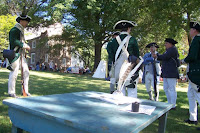
Reenactment of Peace Conference at Christopher Billopp's Bentley Manor (Conference House), Staten Island, September 11, 1776.

The Reenactment Unit is The 4th Battalion New Jersey Volunteers (a Loyalist Unit). I participated as a common soldier from 2008 to 2014.
Todd Braisted, noted Historian of all things Loyalist. For more info, see
Revolutionary War Loyalist history and genealogy
Getting SI signatures to Loyalty Oaths to King George III
A beautiful Loyalist walking the grounds of the Conference House
Me, Native Staten Islander loyal to the King of England

Loyalists troops standing guard
View of Perth Amboy
Frankin, Adams and Rutlege arrive from across the Authur Kill
 to participate in the Peace Conference


Thursday, October 24, 2013

The Revolutionary War in Richmond County, New York (Prelude) 1760 to 1774

The somewhat secluded nature of Staten Island in the 17th and 18th centuries afforded its citizens with relative peace and prosperity after the first Dutch settlers battled with the local Indians and struggled to gain a foothold at Oud Dorp (Old Towne).

Early descriptions of the Island paint a landscape as a "lush and fragrant garden" with a good supply of fresh spring water and an abundance of hardwood trees. Dutch yeomen farmers took advantage of the mixture of clay and sandy soil, in addition to the abundance of Oyster beds in and around the many coves and inlets of the Island.

A south west view of the city of New York, in North America = Vue de sud ouest de la ville de New York dans l'Amérique septentrionale. Thomas Howdell 1768.

The sparsely populated Island was divided into Southfield, Northfield, Westfield and Castletown, the latter overlooking Upper New York Bay.

From a publication in London, dated 1760, we abstract the following description of the residents of Staten Island at that time: " Staten Island at its east end has a ferry of three miles to the west end of Long Island; at its west end is a ferry of one mile to Perth-Amboy of East Jersies; it is divided from East Jersies by a creek; is in length about twelve miles, and about six miles broad, and makes one county, called Richmond, which pays scarce one in one and twenty of the provincial tax; it is all in one parish, but several congregations, viz., an English, Dutch, and French congregation; the inhabitants are mostly English; only one considerable village called Cuckold's-town."

1775

_________________________________________________________
Christopher Billoppe (Morris's Mem.)
Since there were no delegates being sent to the Second Continental Congress in 1775, Richmond became notorious for its Loyalist sympathies. Christopher Billoppe, the wealthiest of the Loyalists, owned Bentley Manor at the extreme southern tip of the Island. The opinion which George Washington had formed of the people of Staten Island, as well as of their immediate neighbors at Amboy, may be learned from the following extract from one of his letters:

"The known disaffection of the people of Amboy, and the treachery of those of
Staten Island, who, after the fairest professions, have shown themselves our
inveterate enemies, have induced me to give directions that all persons of known
enmity and doubtful character should be removed from these places."
Joseph Christopher House. Photo (C) Nick Matranga
The New York Provincial Congress had swayed the merchants and farmers to appoint members to a committee of safety or risk continuing their goods being boycotted by other local towns in New Jersey.

The Committee of Safety included Joseph Christopher (see photo at right), David Latourette, Peter Mersereau and John Tyson along with seven other men.


Since a boycott of all goods being traded with the British was instituted by the Committee, the smuggling of produce, livestock and other goods continued. The British ship James had twice attempted to unload its goods at the port of New York, but was quickly turned away. She ship eventually attempted to disembark its goods at Staten Island with the assistance of three Island residences.
1776

______________________________________________________

In June 1776 the ships began to arrive off of Staten Island, and slowly entered the Narrows into Upper New York Bay.  By the beginning of August, an estimated 30,000 ships were anchored in the harbor and directly off of Staten Island. The soldiers disembarked and started to set up camp all over the Island, chopping down the forests for their cabins and fire wood and foraging for cattle and food on the small farms that dotted the Island.  General Howe had explicitly forbade foraging and stealing from the local farmers, but the soldiers served themselves to the generous amounts of apples, peaches and cherries from the numerous orchards along the south shore.
(Above) A View of the Narrows between Long Island and Staten Island, with Our Fleet at Anchor and Lord Howe Coming In. Drawing by Captain Lieutenant Archibald Robertson, Royal Engineers, 1776. (NYPL)

General Howe set up his headquarters near the Decker Ferry on the shore road along the Kill van Kull at the Adrian Bancker house. British troops were billeted in the Rose & Crowne Inn at New Dorpe, where the Olde King's Highway crosses the main road of the town. The Black Horse Tavern nearby was also commandeered for the use of the Officers and their Aides-de-Camp while stationed on the Island.

A Hessian soldier named Baurmeister recorded a description of the British forces encamped at Staten Island for the 14th and 15th of August. His division had sent 132 soldiers to the Hospital encampment, due to scurvy:

"We found the Eglish troops, which had been driven out of Boston encamped on Staten Island on eight different heights. 


  1. At Amboy Ferry, Lieutenant General Clinton with 2 brigades and half of an artillery brigade. 
  2. Between Amboy Ferry and the Old Blazing Star (now Rossville), Brigadier General Leslie with 3 brigades and half an artillery brigade.
  3.  At the Old Blazing Star, Brigadier General Farrington with 2 brigades and two 12-pounders and also half a troop of light dragoons to carry dispatches. 
  4. At the New Blazing Star (at Long Neck, now Travis), Brigadier Generals Smith, Robertson and Agnew with 3 brigades and the other half of light dragoons. 
  5. At Musgrower's Lien [?](Lane?), Lieutenant General Percy and Brigadier general Erkine with 2 brigades and four 6-pounders and one officer and twnty-five light dragoons. 
  6. At the point opposite Elizabeth town Ferry, Major General Grant with one brigade, two light guns, and fifteen dragoons. 
  7. At the Morning Star (the country seat of Henry Holland, on the northern side of the island), Lieutenant General Cornwallis with two and a half brigades, six 12-pounders, four howitzers, and fifteen dragoons. 
  8. At Decker's Ferry (now Port Richmond), Major General William James with the 37th and 52nd Regiments and two light guns. 
  9. To the right of Decker's Ferry, in a country house close to the shore opposite New Jersey, Major General Vaughan with six grenadier battalions, the 46th Regiment, the rest of the disembarked artillery, the rest of the light dragoons, and General Howe's headquarters. 
Lieutenant-Colonel Dalrymple was in command if the trenches thrown up on Staten Island, which is fifteen English miles long and five wide."
_______________________
From Revolution in America: Confidential Letters and Journals 1776-1784 of Adjutant General Major Baurmeister of the Hessian Forces. Translated and annotated by Bernhard A. Uhlendorf. Rutgers University Press, New Brunswick, New Jersey, 1957.

1777
_________________________________

All images from: ARCHIBALD ROBERTSON: HIS DIARIES AND SKETCHES IN AMERICA, 1762-1780. Spencer Collection, The New York Public Library.
The New York Public Library Digital Collections.
View from Staten Island 2d July 1777.

1778
 ___________________________________________________

Kepp's Bay 17th Augt. 1778 where the troops landed 15th Septr. 1776. Phoenix 44 Capt. H. Parker, Roebuck 44 Hammond. Carisford 28 Fanshaw. Rose 20 Js. Wallace. 12th Augt. 1778.
New York from Brooklyn Heights.

1779

 ___________________________________________________

View from Peaks Kill looking south. . .3 June 1779.

1780

__________________________________________________

1781

__________________________________________________

 
View of the North River, looking north toward Fort Washington. 16 October 1781.

Wednesday, October 23, 2013

British Army at Staten Island, N.Y.


Commander in Chief, General the Honorable Sir William Howe, K. B.
Second in Command, Lieutenant-General Henry Clinton
Third in Command, Right Honorable Lieutenant-General Earl Percy
___________________________________________________
1st Brigade. Major-General Pigot; 4th Regiment, Major James Ogilvie; 15th Regiment, Lieutenant-Colonel Bird; 27th Regiment, Lieutenant-Colonel J. Maxwell; 45th Regiment, Major Saxton.
2d Brigade. Brigadier-General Agnew; 5th Regiment, Lieutenant-Colonel Wolcot; 28th Regiment, Lieutenant-Colonel Rob. Prescott; 35th Regiment, Lieutenant-Colonel Robert Carr; 49th Regiment, Lieutenant-Colonel Sir Henry Calder, Bart.
3d Brigade. Major-General Jones; 10th Regiment, Major Vatass; 37th Regiment, Lieutenant-Colonel Robert Ambercromby; 38th Regiment, Lieutenant-Colonel Wm. Butler; 52d Regiment, Lieutenant-Colonel Mungo Campbell.
4th Brigade. Major-General James Grant; 17th Regiment, Lieutenant-Colonel Mawhood; 40th Regiment, Lieutenant-Colonel James Grant; 46th Regiment, Lieutenant-Colonel Enoch Markham; 55th Regiment, Captain Luke.
5th Brigade. Brigadier-General Smith; 23d Regiment, Lieutenant-Colonel J. Campbell; 43d Regiment, Lieutenant-Colonel George Clarke; 14th Regiment, Lieutenant Colonel Alvred Clarke; 63d Regiment, Major Francis Sill.
6th Brigade. Brigadier-General Gou. Robertson; 23d Regiment, Lieutenant-Colonel Benj. Bernard; 44th Regiment, Major Feury Hope; 57th Regiment, Lieutenant John Campbell; 64th Regiment, Major Hugh McLeroch.
7th Brigade. Brigadier-General Wm. Erskine, quartermaster general; 17th Light Dragoons, Lieutenant-Colonel Birch; 71st Highlanders, 1st Battalion, Major John MacDowell; 2d Battalion, Major Norman Lamont.
Brigade of Guards. Major-General Matthew; Light Infantry Brigade, Brigadier-General Honorable Alexander Leslie; 1st Battalion Light Infantry, Major Thomas Musgrave; 2d Battalion Light Infantry, Major Straubenzie; 3d Battalion Light Infantry, Major Honorable John Maitland; 4th Battalion Light Infantry, Major John Johnson.

Reserve. Right Honorable Lieutenant-General Earl of Cornwallis; Brigadier-General the Honorable John Vaughan; 33d Regiment, Lieutenant-Colonel Webster; 42d Regiment (Royal Highland), Lieutenant-Colonel Thomas Stirling; 1st Battalion Grenadiers, Lieutenant-Colonel Honorable Henry Monckton; 2d Battalion Grenadiers, Lieutenant-Colonel William Meadows; 3d Battalion Grenadiers, Major Thomas Marsh; 4th Highland Grenadiers, Major Charles Stewart; Royal Artillery and Engineers, Brigadier-General Cleveland.

Thursday, February 24, 2011

Lieutenant Colonel Edward Vaughn Dongan (Loyalist Staten Islander)

Lieutenant Colonel Edward Vaughn Dongan, commander of the 3rd Battalion of New Jersey Volunteers in Skinner's Loyalist brigade was mortally wounded in a skirmish, midway between the Old Blazing Star Ferry and Prince's Bay. He was taken to a local farm (which I have yet to identify).  It may very well be The Abraham Manee Farmhouse in Prince's Bay, where British redoubts have been discovered nearby.


Tuesday, February 22, 2011

Lookout Place, the British Garrison at Richmondtowne, Staten Island


Lookout Place or Fort Hill was a Revolutionary War British garrison, or earthen mound-fortress at the top of LaTourette Hill in Historic Richmondtown, Staten Island, New York. The redoubt was constructed in 1776 by British Regulars during the occupation of Richmond County. General William Howe planned his successful capture of New York City while encamped on the Island, along with 30,000 British and Hessian soldiers joining after the arrival of his brother Admiral Richard Howe. The fort overlooked the Old Mill Road, Fresh Kills St. Andrews Church and the town of Richmond, then referred to as Cuckoldstown, in the valley just below LaTourette Hill.

The hilltop was widely denuded of trees by the British during the war, allowing the soldiers to have unobstructed views of Lower New York Bay and the Arthur Kill. Extensive archeological digs have taken place at the turn of the last century, revealing all manner of British accuetrament, from remnants of weaponry to soldier coat buttons, shoe buckles and pottery fragments.


Robert Rogers created a new unit while encamped at Richmondtown called The Queen's Rangers named after Charlotte, wife of King George III. It grew to 937 officers and men organized into eleven companies of about thirty men each and an additional five troops of cavalry.

Rogers did not prove successful in this command and he left the unit on January 29, 1777.  On October 15, 1777, John Graves Simcoe was given command. He turned the Queen's Rangers into one of the most successful British regiments in the war.

The Narrows, the entrance to New York Harbor (c. 1800)

Sunday, August 29, 2010

Fountain House and a Flirtatious Loyalist


The Fountain House, built in 1668 and used as Richmond's first courthouse, stood across from The Black Horse Tavern during the American Revolution. Generals Percy and Carleton, along with Captain Montresor (a British Military engineer) often stopped here. A flirtatious young Loyalist, Margaret Moncrieffe resided here with her father, Major Thomas Moncrieffe in the summer of 1776. She was introduced to General Howe and his staff, and was frequently seen cavorting with the best men on the General's staff. She eventually married Captain John Coughlen. It was demolished in 1937.

One of Montresor's maps of Lower Manhattan during the Revolution.

The General Howe Map of Staten Island, 1776


The resulting map of Staten Island was ordered by General Howe shortly after the British landed at Staten Island in July of 1776. According to the Staten Island Historian, the map was found in the Duke of Northumberland's collection in England, and is claimed to have been surveyed without any surveying instruments; hence the inaccurate shape of the Island. It also shows a conflict as to where General Howe's headquarters were located. The Howe map marks the Bancker house, located near the Decker Ferry in Port Richmond as his headquarters. Legend has it that General Howe was staying at the Rose & Crowne at Newe Dorpe. He may have been using both the Bancker residence and the Tavern at different intervals during his stay on Staten Island. The Taylor and Skinner map, another British map commissioned in 1783 is an extremely accurate depiction of the Island! I have yet to see this map, as it is in the U.K. archives.

A British box sextant (pictured below), late 18th century.

This was used on shore by military and naval officers busily engaged in surveying the colony of British Columbia. Light, portable and easier to transport, it was one of essential the tools for Colonial expansion and mapping. Like a nautical sextant, the box sextant measures angles, but it is smaller, enclosed version placed inside a cylindrical box. Its graduated arc is at half degrees from 0° to 120°. The readings on its vernier were read to single minutes using a magnifying glass. The small removable telescope was used to take long sights, but ordinary observations were usually made through a peephole in the glass. The top (lid) of the cylindrical brass box has been removed to show the knobs that work the sextant. The large knob operates a pinion that engages the toothed, circular segment inside the sextant that mounts the index glass and index arm. The smaller knobs are adjusting screws to eliminate index error and adjust the horizon glass.

Tuesday, August 10, 2010

Old Mill Road, Richmondtown, Staten Island, in Summer (c. 2007)

A large swath of the Greenbelt that has been unaccessible to hikers, naturists and bird-watchers will finally have a bikeway and hiking trail through this densely forested area which is the Lauterette Woods. Richmond Creek and the marshland bird life will finally be viewable from the trail. It will be completed by 2009. See Nick's pictures of the history of Old Mill Road 100 years ago and Old Mill Road today. Actually it is more densely forested now than it has been for the past 200 years (most of the Island was cleared for farming, lumber trade and firewood in the 18th Century.

The Black Horse Tavern, New Dorpe, Staten Island, N.Y.


Morris's Memorial History of Staten Island, New York By Ira K. Morris: "OLD BLACK HORSE NEW DORP
British Troops were billeted in the Black Horse Tavern (left, drawing @ 1800) during the American Revolution. The picture at right is dated @ 1906. It has been since been demolished.


The Rose and Crown, Richmond, NY Morris's Memorial History of Staten Island,
New York By Ira K. Morris:
Photo (c) Nicholas Matranga
OLD ROSE AND CROWN FARM HOUSE NEW BY THE HUGUENOTS ABOUT 1660 is 1854 From a ketch by Mrs S rah Robert Morris
General William Howe read the Declaration of Independence to his troops while billeted in this farm-house/Inn, a few days after the 4th of July, 1776. It was demolished in 1854. All that remains is a marker on a stone at the corner of New Dorpe Lane and Richmond Road (The King's Highway).  Many British Officers participated in raucous and debauched behavior while garrisoned at Staten Island. One particular event one a nearby hillside lead to a duel with one officer being mortally wounded. Many Courts Martial were issued in the ensuing seven-year British occupation.

Lookout Place, the British Garrison on Staten Island


Lookout Place or Fort Hill was a Revolutionary War British garrison, or earthen mound-fortress at the top of LaTourette Hill in Historic Richmondtown, Staten Island, New York. The redoubt was constructed in 1776 by British Regulars during the occupation of Richmond County. General William Howe planned his successful capture of New York City while encamped on the Island, along with 30,000 British and Hessian soldiers joining after the arrival of his brother Admiral Richard Howe. The fort overlooked the Old Mill Road, Fresh Kills St. Andrews Church and the town of Richmond, then referred to as Cuckoldstown, in the valley just below LaTourette Hill.

The hilltop was widely denuded of trees by the British during the war, allowing the soldiers to have unobstructed views of Lower New York Bay and the Arthur Kill. Extensive archeological digs have taken place at the turn of the last century, revealing all manner of British accuetrament, from remnants of weaponry to soldier coat buttons, shoe buckles and pottery fragments.

Robert Rogers created a new unit while encamped at Richmondtown called The Queen's Rangers named after Charlotte, wife of King George III.